Game 1 tips off tomorrow night at Frost Bank Centre in San Antonio, and the basketball world already knows this is more than a championship series. The 2026 NBA Finals pit the San Antonio Spurs against the New York Knicks — a rematch of the 1999 Finals that feels less like a scheduling coincidence and…
Game 1 tips off tomorrow night at Frost Bank Centre in San Antonio, and the basketball world already knows this is more than a championship series. The 2026 NBA Finals pit the San Antonio Spurs against the New York Knicks — a rematch of the 1999 Finals that feels less like a scheduling coincidence and more like narrative architecture. At the centre of it stands Victor Wembanyama, 22 years old and in his third NBA season, with a chance to do something only the rarest players in league history have done: win a title before anyone has finished processing what he actually is. The unanimous 2026 Defensive Player of the Year, a top-three MVP finisher, and the man who just eliminated the 64-win defending champion Oklahoma City Thunder in seven games. Tomorrow night, a coronation vote begins.
The anticipation has been building for weeks, and the sheer volume of interest tells its own story. Across every major diverse sportsbook, the Finals have generated some of the heaviest pre-series action of the decade — not just on the outright winner, but on player props, game totals, and series length markets that reflect how genuinely uncertain this contest feels. The Spurs opened as slight favourites, but the Knicks’ 11-game playoff winning streak has kept the line tight enough to suggest the oddsmaking world considers this a coin flip. When the market can’t separate two teams, the basketball is usually exceptional.
The Duncan Parallel — and Why It Only Goes So Far
The 1999 comparison is irresistible, and every major outlet is running some version of it. Tim Duncan, 22 years old, first overall pick, led the Spurs past the Knicks for San Antonio’s first championship. Now Wembanyama, 22, first overall pick, faces the same franchise in the same round, wearing the same jersey. The symmetry is almost too clean.
Where it holds up: both players anchored elite defences, both carried rosters short on marquee star power, and both reached the Finals ahead of any reasonable timeline. Where it breaks down is more interesting. Duncan inherited David Robinson and a playoff-tested supporting cast built over the years. Wembanyama’s co-stars — Stephon Castle, Dylan Harper, De’Aaron Fox — are constructing their résumés in real time, on the biggest stage, with no safety net. Duncan’s 1999 Spurs benefited from a lockout-shortened season. Wembanyama’s 2026 Spurs beat a full-strength Oklahoma City team that won 64 games and entered the playoffs as the consensus favourite to repeat. The parallel is poetic, but the context arguably makes what Wembanyama has already accomplished more impressive.
What Wembanyama Did to Oklahoma City — and What It Means
The Western Conference Finals was the series that turned Wembanyama from a generational prospect into a generational force. It started in Game 1 with a performance that ESPN’s analysts immediately labelled his “Thanos moment”: 41 points, 24 rebounds, and a 28-foot three-pointer to force overtime — on the road, against the back-to-back MVP in Shai Gilgeous-Alexander, in a game the Spurs were widely expected to lose. That single night rearranged the way the basketball world talked about Wembanyama. He was no longer the player who would eventually dominate the league. He was dominating it now.
The series arc only reinforced that shift. Down in the series, the Spurs clawed back. Games 6 and 7 became a collective closing statement — Wembanyama’s two-way impact suffocated Oklahoma City’s system on one end and powered San Antonio’s transition offence on the other. The defining image came in the final minutes of Game 7: both Gilgeous-Alexander and Alex Caruso drove hard to the basket, realised what awaited them at the rim, and threw desperate bail-out passes back to the perimeter. Two elite players — one of them the reigning two-time MVP — are retreating from the paint because of one man. SGA finished with 35 points, and it was not enough. Wembanyama’s playoff averages read 23.2 points, 10.8 rebounds, and league-best defensive metrics by any measure. The numbers are outstanding. Paired with the moments that produced them, they become historic.
What Stands Between Wembanyama and History
The Knicks are not here to play a supporting role in someone else’s coronation. Reducing them to a narrative obstacle would be a mistake that this series will punish quickly.
New York arrives on an 11-game playoff winning streak — the longest in the 2026 postseason — with a staggering +271 point differential across that run, the largest in NBA playoff history over such a span. They swept the Cleveland Cavaliers in the Eastern Conference Finals and return to the championship round for the first time since 1999, carrying the kind of offensive firepower that has overwhelmed every defence placed in front of it. Jalen Brunson has been the engine, averaging 26.9 points per game this postseason while orchestrating an offence that posted a 123.0 offensive rating in two regular-season meetings with San Antonio — the highest figure any opponent managed against the Spurs all year.
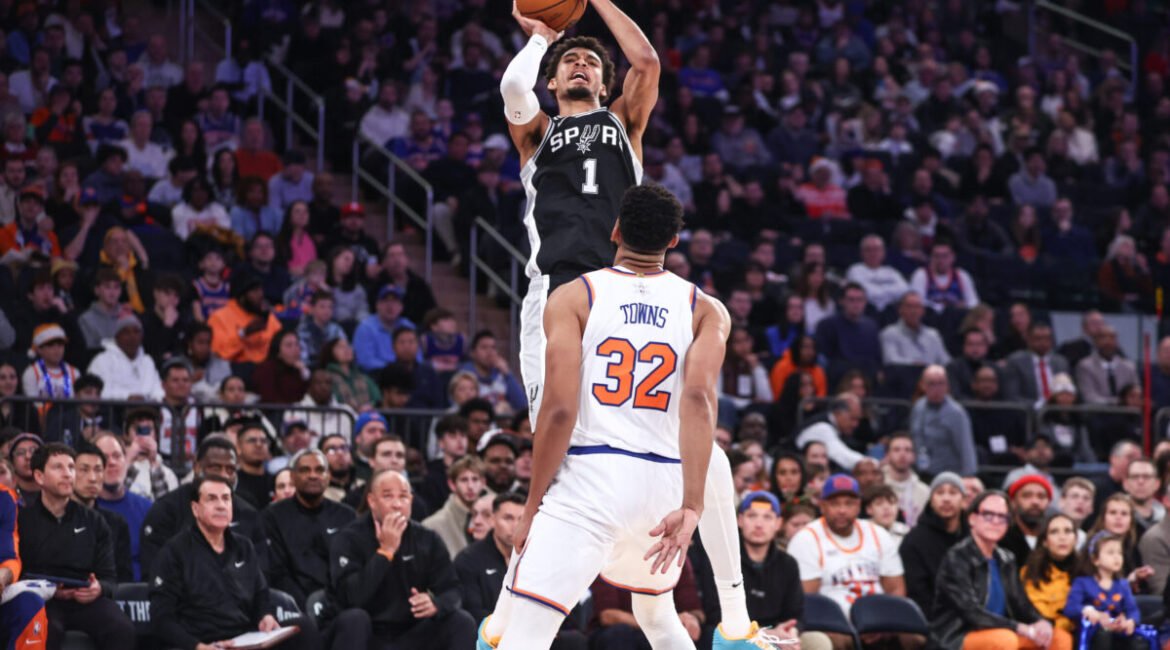
Then there is Karl-Anthony Towns, and he may be the matchup that decides this series. Towns is a seven-footer who drills contested threes, drives closeouts, and creates defensive decisions that no other centre in the league forces. The Spurs must choose: does Wembanyama guard Towns directly, risking foul trouble and pulling the league’s most impactful rim protector away from the paint? Or does someone else take the assignment, handing Towns a mismatch he will exploit? There is no comfortable answer. Add Miles McBride shooting 42.9% from three this postseason, Landry Shamet at a scorching 60%, Josh Hart’s relentless offensive rebounding, and Mitchell Robinson returning with a cast on his fractured pinky, and the picture is clear: the Knicks have the depth, the shooting, and the rest advantage — ten full days off compared to San Antonio’s three — to make this a genuine seven-game fight.
The Era Begins Regardless
Whether Wembanyama lifts the Larry O’Brien Trophy this month or not, the 2026 Finals mark the formal start of his era. At 22, he has outdueled the back-to-back MVP, anchored the league’s best defence, won Defensive Player of the Year unanimously, and carried a roster with zero prior playoff experience to the championship round. The question is no longer whether he will dominate the NBA. It is how many titles he will collect while doing so. San Antonio’s roster construction supports sustained success: Castle, Harper, Fox, Sixth Man of the Year Keldon Johnson, plus four picks in the 2026 Draft and 21 combined selections through 2033. The infrastructure for a dynasty is already in place. Wembanyama is the reason it could become one.
For those following the Finals through a betting lens, it is worth remembering that no predicted outcome is guaranteed, regardless of how compelling the storylines or how dominant a player appears. Sports betting should remain entertainment — never a financial strategy. Setting limits before placing any wager, never chasing losses, and stepping away the moment it stops being enjoyable are important for responsible gambling purposes. Resources like BeGambleAware and GamCare are available for anyone who needs support.
The parallel that matters most is not Duncan in 1999. It is what Duncan built after 1999 — five championships across fifteen years, a franchise defined by one player’s sustained excellence. Wembanyama’s Spurs have the assets, the youth, and the centrepiece to chase that kind of legacy. It starts tomorrow night in San Antonio. The basketball world will be watching. So will history.